
Inside the Rural Health Center Where AHEAD Built Surgical Capability From the Ground Up
Tanzania has 367 facilities that provide major surgery. Most of them are in cities. The Maruku Health Center is not in a city. It sits in Maruku Ward, Bukoba District, Kagera Region, where the nearest alternative hospital is 45 minutes away over rough roads. This is the story of how AHEAD turned a facility with no surgical capacity into one that performs cesarean sections under solar power.
AHEAD’s Impact on Health in a Rural District at Maruku Health Center
When Dr. Williams arrived in Tanzania in 1974, there was only ONE pediatrician in the entire country. Now it has a network of physicians, dentists, surgeons, and nurses serving thousands every year. The mission has never changed, but it’s scaling every year.
Most Rural Health Centers in Tanzania Cannot Perform Surgery. This One Can.
Care is organized in tiers in Tanzania’s health system. At the base are dispensaries and health centers that handle outpatient visits and basic treatment. Above them sit district hospitals, regional referral hospitals, and national facilities. The assumption is that complicated cases get referred upward.

The problem is the space between tiers. In Kagera Region, a woman in obstructed labor at a rural health center must be transferred to a district hospital for a cesarean section. That transfer requires a vehicle, a passable road, and time. In Maruku, the transfer takes 45 minutes under the best conditions. During the rainy season or at night, it can take longer. For obstetric emergencies, that gap is where mothers and newborns die.
AHEAD’s approach was not to bypass the system. It was to close the gap inside it. Instead of accepting that a health center cannot perform surgery, AHEAD invested in the infrastructure, equipment, and energy systems required to bring surgical capability to the facility.
Each Piece of Equipment AHEAD Provided Unlocked a Capability That Did Not Exist Before
Building surgical capacity at a rural health center is not a single investment. It is a chain. Each link depends on the one before it. AHEAD built that chain over the years, responding to specific clinical needs as they emerged.
Diagnostic Capability
Without ultrasound, clinicians could not identify complications like placenta previa, breech presentation, or ectopic pregnancy before labor. AHEAD provided ultrasound technology that gave the medical team the ability to detect high-risk pregnancies early and plan interventions rather than react to emergencies mid-delivery.
Surgical and Anesthesia Equipment
A cesarean section requires more than a trained surgeon. It requires a universal anesthesia machine, AEDs for cardiac monitoring, and a full set of surgical instruments. AHEAD provided all of these. In August 2023, the first cesarean section was performed at the Maruku Health Center. Before that date, every mother who needed one had to survive a transfer.
Inpatient Wards
Surgery without recovery space is incomplete. AHEAD funded two maternal inpatient wards and a pediatric ward, giving post-operative mothers and sick children a place to recover under clinical observation instead of being sent home hours after a procedure.
Reliable Energy
During the July 2023 health fair, the generator failed repeatedly. Mid-surgery. The founding board members challenged the team to find a permanent solution. In 2024, AHEAD installed solar panels and a new backup generator. Dr. Andrea Williams-Kingslow then performed the first-ever surgery at the center powered entirely by solar energy. Reliable power is not an upgrade. Reliable power is not an upgrade. In a surgical theater, it is the difference between life and death.
WHAT THIS MEANS FOR ONE FAMILY
Naeema delivered her baby on the roadside after contractions stopped her halfway to the center. A motorcyclist rushed her in. The medical team stabilized both her and her newborn.
That was one emergency. But what happened next is the point.
The same equipment that saved Naeema has since served hundreds of mothers across the district. Every cesarean section performed after August 2023, every high-risk pregnancy caught early by ultrasound, every post-operative recovery in the maternal ward traces back to infrastructure that was already in place when they arrived.
One emergency built the case. The system AHEAD built answered every emergency after it.
A Facility Built for Sustainability, Not Dependency
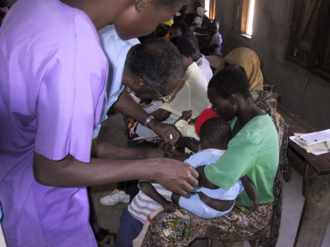
AHEAD does not operate the Maruku Health Center. Tanzanian health workers staff it year-round within the national health system. AHEAD’s role is infrastructure, equipment, and capacity building. Once a year, volunteer specialists self-finance their travel to provide care the center cannot offer year-round. But the core maternal and primary care services never stop. Missions leave. Infrastructure stays.
THE NEXT PHASE
The Surgical Chain Is Built. Now, AHEAD Is Extending It.
The Maruku Health Center can now perform surgeries. It has solar power and inpatient wards. The next phase addresses the gaps that remain.
Clean Water.
AHEAD is planning a solar-powered borehole drilled well system for the health center. A borehole has a lifespan of approximately 50 years with minor maintenance. Surgical and maternity environments require clean water for sterilization, handwashing, and patient care. The site has not yet been selected; hydrogeological surveys are needed first.
A Permanent Dental Facility.
AHEAD is fundraising to renovate a dedicated dental office at the center. The total project cost is $66,625, covering construction ($15,000), equipment ($47,250), and student dental visits ($4,375). Once complete, 875 students from Maruku Secondary School and neighboring schools will receive dental care twice per year.
Expanded Capacity for Male Patients
The center’s initial build focused on maternal and pediatric care. AHEAD is now working to expand services for adult male patients who currently have limited clinical access in the district.
Fund What Comes Next
Your Donation Funds Specific Infrastructure at the Maruku Health Center
AHEAD operates lean. No overheads, no middlemen. Here is exactly where your contribution goes at this facility.
- $50 Provides a birthing kit with supplies for one safe, sanitary delivery at the center.
- $250 Funds essential medical supplies for one week of primary care operations.
- $500 Covers pre-operative testing and 361-mile patient transport for one joint replacement surgery in Arusha.
- $1,000 Funds one full day of the annual Community Health Fair at the center.
- $5,000 Contributes directly to the $66,625 dental office renovation project.
QUESTIONS ABOUT MARUKU HEALTH CENTER
Who operates the Maruku Health Center day-to-day?
The center is staffed and managed by Tanzanian health workers within the national health system. AHEAD’s role is infrastructure investment, equipment provision, and periodic specialized care through the annual health fair. The center operates 365 days a year, independent of AHEAD’s volunteer schedule.
What surgical procedures can the center perform now?
Since August 2023, the center has had full cesarean section capability. It is equipped with a universal anesthesia machine, AEDs, ultrasound, and surgical instruments. Since 2024, all procedures can run on solar power with generator backup.
How does the center handle cases it cannot treat?
Cases requiring advanced specialty care are referred to district or regional hospitals. For patients needing joint replacement surgery, AHEAD partners with WOGO to fund and coordinate the 361-mile journey to Arusha Lutheran Medical Center, covering transport, pre-operative testing, and patient liaison.
What is the dental office renovation and why does it matter?
AHEAD is fundraising $66,625 to build a permanent dental facility at the center. Currently, dental care is only available during annual camps. A permanent office will serve 875 students twice per year and provide ongoing preventive and restorative dental care to the surrounding community.
Can I visit or volunteer at the center?
Yes. AHEAD recruits licensed medical professionals and skilled volunteers for its annual mission trip (July 9 to 24, 2026; $4,850 self-funded trip fee). Visit the Volunteer page to learn more and apply.
EXPLORE RELATED PROGRAMS
Continue Learning About AHEAD’s Work
Community Health Fair
Three days, 700+ patients, every July at Maruku Health Center.
Oral Health & Dental Program
Annual dental camps and the $66,625 renovation that will make care permanent.
Solar Energy Legacy and Projects
From 1991 solar lights to the 2024 surgical installation, three decades of energy solutions.